
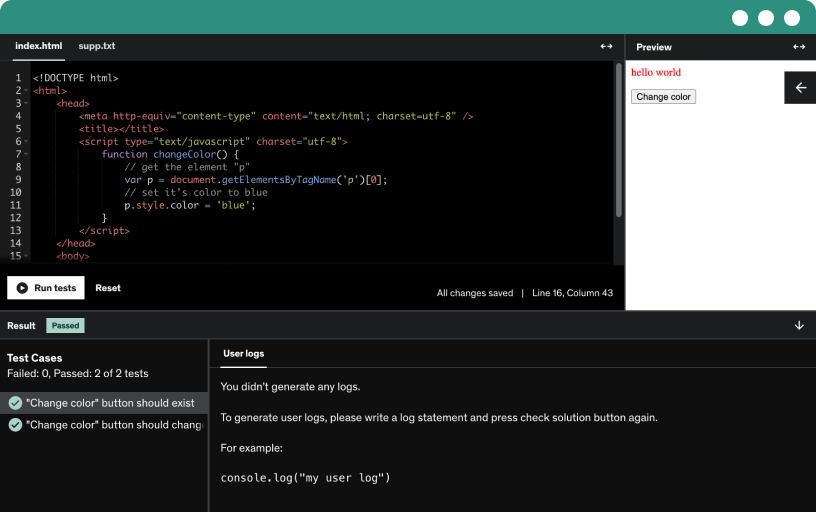
This course includes our updated coding exercises so you can practice your skills as you learn.
See a demo
In this SQL tutorial, the Complete Oracle SQL Bootcamp course participants will learn about what a database is and why we need to use databases with real-world examples.
In this lecture, our students going to learn what a table is and why we need to use the tables.
This lecture is about how to use the Udemy platform. And also includes some useful tips to get most of out the course.
In this lecture, this course participants will be able to claim & download their special quick recap document for The Complete Oracle SQL Bootcamp course.
In this lecture, you're going to learn what the pluggable database (multitenant architecture) is in Oracle Database.
In this SQL tutorial, the participants will learn how to get a database to proceed with the Complete Oracle SQL Bootcamp 2022 course.
In this SQL tutorial, the Complete Oracle SQL Bootcamp course participants will learn how to download the Oracle Database 23ai Virtual Machine Image (OVA) file, set up a fully functional database ready for use.
In this SQL tutorial, the Complete Oracle SQL Bootcamp course participants will learn how to download and install the VirtualBox virtualization software, enabling them to use the image we downloaded in the previous lesson. This software will provide access to a pre-configured Linux operating system with an installed database, ready for use.
In this SQL tutorial, the Complete Oracle SQL Bootcamp participants will learn how to import the VirtualBox image we downloaded in the previous lesson into the VirtualBox software, ensuring a seamless setup and smooth operation.
In this SQL bootcamp tutorial, the Complete Oracle SQL Bootcamp participants will learn how to download and install the SQL Developer tool on their Windows machine, and connect it to a database running on a Linux server that we set up in previous lessons. The advantage of this setup is that we’ll use the pre-configured Linux image solely as the database server, while SQL Developer, installed on Windows, will handle the queries. This configuration enhances both performance and stability, allowing SQL Developer to run faster and more smoothly.
In this SQL tutorial, the Complete Oracle SQL Bootcamp participants will learn how to use the SQL Developer tool to run queries and follow along with the course content.
For the students who could succeed to complete the Option-1
In this SQL tutorial, the complete SQL Bootcamp course participants will learn about the Oracle Database 19c installation.
Lecture keywords: "oracle", "oracle sql", "oracle database", "oracle database installation", "oracle database 19c installation".
In this lecture, our students are going to learn how to unlock the HR schema to practice throughout the course.
This lecture covers how to download and configure Oracle SQL Developer software and how to connect to the Oracle Database 19c.
In this SQL tutorial, the course participants will learn about the easiest way how to install Oracle Sample Schemas to be able to work with many database sample schemas provided by Oracle.
This code includes the SQL script to generate the HR schema with all its data.
Note 1: You can use this script if you could not have the HR schema properly.
Note 2: Just select all the script and execute in one step when connected as the SYS or SYSTEM user.
Introduces which SQL statements we are going to use in this course. (Oracle's specific SQL details are in next lessons.)
This lecture introduces shows how much we appriciate your thoughts.
In this lesson, we're going to talk about Oracle Data Types which are;
In this lecture, students are going to learn one of the most important concepts of the database terminology which is called "Null". We've explained what a NULL value is in this lecture in details.
This lesson includes Oracle DESC or DESCRIBE Command.
This lesson teaches how to see a better description and some statistics of a table using the INFO[RMATION] and INFO[RMATION]+ Commands.
Includes the code samples used in the INFORMATION Command lecture
This lesson covers Oracle SQL Statement Basics.
This lecture includes the code samples we used within the previous lecture
This lecture explains how to read the Oracle (ORA) error messages and how to take an action to solve your code problems
This lecture includes the code samples we used within the previous lecture
This lesson covers Oracle SELECT Statements.
This lecture includes the code samples we used within the previous lecture
This lesson covers Oracle Column Aliases.
This lecture includes the code samples we used within the previous lecture
This lesson covers Oracle Quote (q) Operator.
This lecture includes the code samples we used within the previous lecture
This lesson covers the Oracle Distinct (DISTINCT) and UNIQUE operators.
This lecture includes the code samples we used within the previous lecture
This tutorial explains the solution to the related SQL coding exercise.
In this SQL tutorial, we cover the Concatenation ( || ) Operator in Oracle SQL with various examples.
This lecture includes the code samples we used within the previous lecture
This lesson covers Oracle SQL Arithmetic Operations like;
and covers NULL values.
This lecture includes the code samples we used within the previous lecture
This tutorial explains the solution to the related SQL coding exercise.
In this lesson, students are going to learn the WHERE clause and how to use the WHERE clause in SQL statements and the Oracle Database with its various examples.
This lecture includes the code samples we used within the previous lecture
In this SQL tutorial, the Complete SQL Bootcamp course participants will learn about Comparison Operators ( <, >, < = , >=, <>) in Oracle SQL with hands-on examples.
This lecture includes the code samples we used within the previous lecture
In this lesson we're going to learn BETWEEN ... AND Operator in Oracle Database.
This lecture includes the code samples we used within the previous lecture
In this lesson we're going to learn IN Operator in Oracle Database.
This lecture includes the code samples we used within the previous lecture
In this lesson we're going to learn LIKE Operator in Oracle Database.
This lecture includes the code samples we used within the previous lecture
In this SQL tutorial, the Complete Oracle SQL course participants will learn about what the IS NULL Operator is and how to use the IS NULL operator in Oracle SQL.
This lecture includes the code samples we used within the previous lecture
In this lesson, students are going to learn Oracle Logical Operators which are;
AND Logical Operator
OR Logical Operator
NOT Logical Operator
This lecture includes the SQL code samples we used within the previous lecture
In this lesson, we're going to learn Rules of Precedence in Oracle Database.
Precedence is the order in which Oracle evaluates different operators in the same expression. When evaluating an expression containing multiple operators, Oracle evaluates operators with higher precedence before evaluating those with lower precedence. Oracle evaluates operators with equal precedence from left to right within an expression.
Operator, Operation
+, - identity, negation
*, / multiplication, division
+, -, || addition, subtraction, concatenation
=, !=, <, >, <=, >=, IS NULL, LIKE, BETWEEN, IN comparison
NOT exponentiation, logical negation
AND conjunction
OR disjunction
This lecture includes the SQL code samples we used within the previous lecture
In this lesson, students are going to learn the ORDER BY Clause in SQL and how to use the ORDER BY Clause in the Oracle Database by its various examples.
This lecture includes the SQL code samples we used within the previous lecture
This lesson covers the ASC (Ascending) and DESC (Descending) operators in SQL and how to use them in the Oracle Database.
This lecture includes the SQL code samples we used within the previous lecture
In this lesson, students are going to learn the NULLS FIRST and NULLS LAST Operators in the Oracle Database.
This lecture includes the SQL code samples we used within the previous lecture
In this lecture, students are going to learn what is ROWID and ROWNUM in SQL, what the ROWID vs ROWNUM differences are.
Lecture keywords: #oracle #sql #rownum #rowid
This lecture includes the SQL code samples we used within the previous lecture
This lesson introduces students to the FETCH clause in Oracle SQL, which is also known as the row limiting clause, that is used to limit rows returned by a query.
This lecture includes the SQL code samples we used within the previous lecture
In this SQL tutorial, students are going to learn a brand new section called "Substitution Variables".
This lecture covers "What a Substitution Variable is" in Oracle and how to use Substitution Variables in SQL Queries with various examples.
This lecture includes the SQL code samples we used within the previous lecture
In this SQL tutorial, participants are going to learn how to use double ampersand (&&) characters as substitution variables in SQL. And also they will learn the DEFINE and UNDEFINE commands to define and undefine substitution variables explicitly.
This lecture includes the SQL code samples we used within the previous lecture
In this SQL tutorial, students are going to learn how to use ACCEPT and PROMPT commands with substitution variables in SQL.
This lecture includes the SQL code samples we used within the previous lecture
In this SQL tutorial, our expert SQL instructors are going to demonstrate how to use SET VERIFY ON and SET VERIFY OFF commands to turn off or turn on substitution operations while performing special operations like the data warehouse operations, data migration, etc.
This lecture includes the SQL code samples we used within the previous lecture
In this lesson, students are going to learn what the function is in the programming context and in Oracle Database.
They will also learn function types in Oracle which are Single-Row Functions and Multiple-Row functions (also called Group Functions).
This lecture is just an overview of Single-row functions in Oracle Database.
In the upcoming lectures, students will see all the subtypes of single-row function in Oracle one by one in detail.
In this SQL tutorial, students are going to learn Case Conversion Functions which are the subtype of the Character Functions in Oracle Database.
And we will cover Case conversion functions below;
LOWER function
UPPER function
INITCAP function
This lecture includes the SQL code samples we used within the previous lecture
In this SQL tutorial, students are going to learn the Oracle Character Manipulation Functions which are the subtype of Oracle String Functions.
Character Manipulation Function in Oracle has 8 functions which are;
SUBSTR function
LENGTH function
CONCAT function
INSTR function
TRIM function
REPLACE function
LPAD function
RPAD function.
In this SQL lesson, students are going to learn;
How to use the Oracle SUBSTR() function to extract a substring from a string,
How to use the Oracle LENGTH() function that returns the number of characters of a specified string,
And lastly, they will also see the Oracle CONCAT function that concatenates two strings and returns the combined string.
This lecture includes the SQL code samples we used within the previous lecture
In this SQL tutorial, students are going to learn the Oracle INSTR() function that searches for a substring in a string and returns the position of the substring in a string.
This lecture includes the SQL code samples we used within the previous lecture
In this SQL Character Functions lecture series, we are going to continue to learn Character Manipulation Functions in SQL.
This SQL tutorial covers;
TRIM function
LTRIM function
RTRIM function and their example usages.
This lecture includes the SQL code samples we used within the previous lecture
In this SQL Character Functions lecture series, we are going to continue to learn the last part of the Character Manipulation Functions in SQL.
This SQL tutorial covers;
REPLACE function
LPAD function
RPAD function and their example usages.
This lecture includes the SQL code samples we used within the previous lecture
In this SQL tutorial, students are going to learn SQL Numeric Functions in other words, SQL Number Functions in the Oracle Database.
The numeric functions we covered in this lecture are;
Round Function
Trunc Function
Ceil Function
Floor Function
Mod Function
Also, the participants will learn how to use other numeric functions in their SQL statements.
This lecture includes the SQL code samples we used within the previous lecture
In this SQL tutorial, the participants will learn Nested Functions which can be placed within other Oracle functions, extending their capability in the Oracle Database.
Lecture keywords: oracle nested functions, nesting functions in Oracle SQL, nested functions in SQL.
This lecture includes the SQL code samples we used within the previous lecture
In SQL tutorial, we are going to introduce Oracle Date Data Types which are;
Date Data Type,
Timestamp Data Type
Timestamp with Time Zone Data Type
Timestamp with Local Time Zone data types.
And you will also see the Oracle Date Format Models in SQL.
In this SQL tutorial, students are going to learn the most commonly used Oracle SQL Date Functions such as sysdate, current_date, systimestamp, current_timestamp, etc. in the Oracle Database.
And they will also learn how to make arithmetic operations on date values.
This lecture includes the SQL code samples we used within the previous lecture
In this SQL tutorial, we will introduce you how to manipulate Oracle date values via Oracle Date manipulation functions such as
Oracle Add_months function
Oracle Months_between function
Oracle Trunc function
Oracle Next_Day function
Oracle Round function
Oracle Last_day function
Oracle Extract function
This lecture includes the SQL code samples we used within the previous lecture
In this lesson we're going to learn Conversion Functions in Oracle Database.
It contains;
- TO_CHAR Function
- TO_DATE Function
- TO_NUMBER Funtion
This lecture includes the SQL code samples we used within the previous lecture
In this lesson we're going to learn
This lecture includes the SQL code samples we used within the previous lecture
In this lesson we're going to learn
This lecture includes the SQL code samples we used within the previous lecture
This SQL tutorial explains how to use the Oracle CASE expression with syntax and examples to perform if-then-else check in SQL programming.
This lecture includes the SQL code samples we used within the previous lecture
This SQL tutorial explains how to use the Oracle SQL DECODE function with syntax and examples.
This lecture includes the SQL code samples we used within the previous lecture
In this SQL tutorial, students are going to learn Oracle Group Functions, in other words, Oracle aggregate functions work and how to apply them to calculate aggregates.
In this SQL tutorial, participants will learn how to use the Oracle AVG() function and we will show you how to apply it to calculate the average of values in various contexts.
This lecture includes the SQL code samples we used within the previous lecture
In this SQL tutorial, students will learn how to count the returning rows of your queries in different ways using the Oracle Count function.
This lecture includes the SQL code samples we used within the previous lecture
This SQL tutorial explains how to use the Oracle MAX function with its syntax and examples.
This lecture includes the SQL code samples we used within the previous lecture
This SQL tutorial explains how to use the Oracle MIN function with its syntax and examples.
This lecture includes the SQL code samples we used within the previous lecture
This SQL tutorial explains how to use the Oracle SUM function with its syntax and examples.
This lecture includes the SQL code samples we used within the previous lecture
In this SQL tutorial, students will learn how to use the Oracle LISTAGG() function to transform data from multiple rows into a single list of values separated by a specified delimiter with various examples.
This lecture includes the SQL code samples we used within the previous lecture
In this SQL tutorial, students will learn the overview of Oracle Group Functions.
This lecture includes the SQL code samples we used within the previous lecture
Welcome to the MOST COMPREHENSIVE Oracle SQL Bootcamp Course on the planet!
Latest Course Updates:
(Dec 2025) : Installing Oracle Database 23 AI section was added! (Brand New)
(Nov 2025) : Brand New Content (Managing Oracle Privileges and Roles) was added!
(Sep 2025) : Brand New Content (Using Oracle FLASHBACK Technologies) was updated!
(Feb 2025) : 3-Real SQL(Over 225+ High-Quality Questions) Certification Exam Samples are added!
(Dec 2024) : More Quiz Questions were added!
Important Notice: This course will be continuously getting updated with more lectures, quizzes, and assessments to enhance your knowledge of Oracle SQL.
Are you a student ready to learn SQL for your lessons?
Do you want to get a better job?
Are you bored with watching a lot of stuff, but could not learn anything?
Do you think you know SQL, but you cannot write SQL codes?
Are you looking for a really professional course?
Then this is the course you are looking for.
You are in the right place!
In this course, all the subjects are explained in professional order.
If you are new to SQL, no problem! You can easily learn all the details of SQL. If you already know SQL and want to improve, this course explains all the details including all of the subjects.
After completing this course, you will learn all that you need to know. If you don't see something in this course, it means you really don't need to know it for now.
Coding can be learned with coding. A course that has no example is not a course at all. And there are hundreds and hundreds of codes in this course.
So come on, what are you waiting for?
Get this course, and get a better job!
Topics covered in the Complete Oracle SQL Bootcamp 2025 Course:
Database Concepts & Terminologies
What is a Database?
What is the Oracle Database?
What is a pluggable database?
What is SQL?
What is a database table?
What is a Relational-Database Management System (RDBMS)?
What is the Entity-Relationship model in SQL?
What is a database schema?
Installing Oracle Sample Schemas (HR, SH, OE, IX, etc.)
Introduction to Database Objects
Downloading and Installing the Oracle Database (Version 12c, 18c, 19c, 21c, 23ai, etc.)
Downloading the Oracle Database Installation File
Installing Oracle Database on Your Local Computer
Working with a Database via a Virtual Machine
Downloading and Installing a Virtualization Software (VirtualBox, VMWare)
Downloading Pre-built Virtual Machine Image
Importing a Virtual Machine into Virtualization Software
Configuring, Using, and Working with Virtual Machines through Virtualization Software
Downloading, Installing, Configuring, and Using the Oracle SQL Developer Software
Connecting to the Oracle Database Using SQL Developer and SQL Plus
Configuring SQL Developer for the first use
Configuring Network Connections to work with Oracle Sample Schemas
Working with Oracle Live SQL
Introduction to Oracle Live SQL Platform
How to use Oracle Live SQL
Retrieving Data from the Database Using SELECT Statements
What is NULL?
SELECT Statements
Using Column Aliases in SQL
DISTINCT and UNIQUE Operators in SQL
Concatenation Operators in SQL
The Quote (q) Operator in SQL
Filtering & Restricting Data returned by SQL Queries using the WHERE Clause
Using the WHERE Clause in SQL
Using Oracle Comparison Operators in SQL
BETWEEN AND Operator in SQL
IN Operator in SQL
LIKE Operator in SQL
IS NULL Operator in SQL
Logical Operators in SQL:
AND Logical Operator
OR Logical Operator
NOT Logical Operator
Oracle Rules of Precedence in SQL
Sorting Data using the ORDER BY Clause
Using the ORDER BY Clause
Using the ASC and DESC Operators
Using the NULLS FIRST and NULLS LAST Operators
Using the FETCH Clause
Using Oracle Substitution Variables
What are Substitution Variables?
Double Ampersand (&&) and DEFINE & UNDEFINE Commands
ACCEPT and PROMPT Commands
SET VERIFY ON / SET VERIFY OFF Commands
Using Oracle Single-Row Functions to Customize the Query Outputs
Introduction to Oracle Single-Row Functions
Character Functions
Case Conversion Functions
UPPER Function
LOWER Function
INITCAP Function
Character Manipulation Functions
SUBSTR Function in SQL
LENGTH Function in SQL
CONCAT Function in SQL
INSTR Function in SQL
TRIM Function in SQL
LTRIM and RTRIM Functions in SQL
REPLACE Function in SQL
LPAD and RPAD Functions in SQL
Numeric Functions
ROUND Function in SQL
TRUNC Function in SQL
CEIL Function in SQL
FLOOR Function in SQL
MOD Function in SQL
Nested SQL Group Functions
Date Data Types and SQL Date Functions
Date Data Types
DATE Data Type in SQL
TIMESTAMP Data Type in SQL
TIMESTAMP WITH TIME ZONE Data Type in SQL
TIMESTAMP WITH LOCAL TIME ZONE Data Type in SQL
Oracle Date Functions
SYSDATE Function in SQL
CURRENT_DATE Function in SQL
SESSIONTIMEZONE Function in SQL
SYSTIMESTAMP Function in SQL
CURRENT_TIMESTAMP Function in SQL
Date Manipulation Functions
ADD_MONTHS Function
MONTHS_BETWEEN Function
ROUND Function
TRUNC Function
EXTRACT Function
NEXT_DAY Function
LAST_DAY Function
Oracle Conversion Functions
TO_CHAR Function in SQL
TO_NUMBER Function in SQL
TO_DATE Function in SQL
Null Related Functions in SQL
NVL Function
NVL2 Function
NULLIF Function
COALESCE Function
Conditional Expressions in SQL
CASE Expressions in SQL
DECODE Function in SQL
Reporting Aggregated Data Using the Group Functions
Introduction to Oracle Group Functions
AVG Function in SQL
COUNT Function in SQL
MAX Function in SQL
MIN Function in SQL
LISTAGG Function in SQL
Overview of Group Functions in SQL
Displaying Data from Multiple Tables Using Joins
What is a SQL Join?
Join Types in Oracle SQL
How to Create a Join in SQL
Natural Join
Join with the USING Clause
Handling Ambiguous Column Names While Joining Multiple Tables
Inner Join (Join with the ON Clause)
Multiple Join Operations
Restricting Joins
Self-Join
Non-Equijoins (Joining Unequal Tables)
Outer Joins in SQL
LEFT OUTER JOIN (LEFT JOIN)
RIGHT OUTER JOIN (RIGHT JOIN)
FULL OUTER JOIN (FULL JOIN)
Cross Join (Cartesian Product or Cross Product)
Oracle's Old Style Join Syntax (Comparison of ANSI vs. Non-ANSI SQL Join Syntaxes)
Using & Building & Analyzing Subqueries
What is a Subquery in SQL?
How to Use Subqueries in SQL?
Subquery Types in SQL:
Single-Row Subqueries in SQL
Multiple-Row Subqueries in SQL
Multiple-Column Subqueries in SQL
SCALAR Subqueries in SQL
Correlated Subqueries in SQL
Using Subqueries as a Table
Using the EXISTS Operator (Semijoins in SQL)
Using the NOT EXISTS Operator
Working with Oracle SET Operators
What are SET Operators and Why are They Used?
UNION Operator
UNION ALL Operator
MINUS Operator
INTERSECT Operator
Combining Multiple Queries Using Multiple SET Operators in Complex SQL Queries
Using Data Manipulation Language (DML) Statements
INSERT Statement
UPDATE Statement
DELETE Statement
MERGE Statement
Multiple INSERT Statements
Unconditional INSERT (INSERT ALL) Statements
Conditional INSERT ALL Statements
Conditional INSERT FIRST Statements
Pivot Insert in SQL
Using Transaction Control Language (TCL) Statements
What is a transaction in SQL?
TCL Commands
COMMIT and ROLLBACK Statements in SQL
Row Locking Mechanism in SQL
SAVEPOINT Statement in SQL
FOR UPDATE Statement in SQL
Using Data Definition Language (DDL) Statements
What are Data Definition Language Statements
Naming Rules & Naming Conventions in Oracle
Creating Tables using the CREATE TABLE statements
CREATE TABLE AS SELECT (CTAS) Statement in Oracle
ALTER TABLE Statement
Marking Columns Unused (Using The SET UNUSED Clause)
READ-ONLY Tables in SQL
DROP TABLE Statement
TRUNCATE TABLE Statement
COMMENT Statement
RENAME Statement
Creating, Using, Working, and Managing Constraints
What is a Constraint in SQL?
Oracle Constraint Types
NOT NULL Constraint
UNIQUE Constraint
PRIMARY KEY Constraint
FOREIGN KEY Constraint
The ON DELETE CASCADE Clause
The ON DELETE SET NULL Clause
CHECK Constraint
Adding Constraints via ALTER TABLE Statements
Dropping (Removing) Constraints
Cascading Constraints in Oracle
Renaming Constraints
Enabling / Disabling Constraints
Status of Constraints
Deferring (Deferrable) Constraints
Creating, Using, and Managing Database Views in Detail
What is a Database View and What is it Used for?
View Types in Oracle
Creating Simple Views
Creating Complex Views
Modifying Views
Performing DML Operations with Views
Using the WITH CHECK OPTION Clause in SQL
Using the WITH READ ONLY Clause on Views
Managing Objects Using Oracle Data Dictionary Views
What are Data Dictionary views in Oracle?
The DICTIONARY View (The Main Dictionary)
USER, ALL, DBA, and V$ Prefixes in Data Dictionary Views
USER_OBJECTS, ALL_OBJECTS, and DBA_OBJECTS Views
USER_TABLES, ALL_TABLES, and DBA_TABLES Data Dictionary Views
USER_TAB_COLUMNS Data Dictionary View
USER_CONSTRAINTS Data Dictionary View
USER_CONS_COLUMNS Data Dictionary View
USER_VIEWS Data Dictionary View
USER_TAB_COMMENTS and USER_COL_COMMENTS Data Dictionary Views
Creating and Using, Working with Sequences in SQL
What is a Sequence?
Creating Sequences
Modifying Sequences
Using Sequences
Using Sequences as Default Values
Sequence Caching
The USER_SEQUENCES View
Using the IDENTITY Column in Oracle
Creating and Using Synonyms
What is a Synonym in SQL
Creating, Using, and Dropping Synonyms
Analyzing The USER_SYNONYMS View
Working with Indexes in SQL
What is an Index in SQL
Index Types in SQL
How to Create Indexes in SQL
How to Create Indexes While Table Creation
How to Remove (Drop) Indexes
Function-Based Indexes
Multiple Indexes on the Same Columns & Invisible Indexes
Analyzing the USER_INDEXES and USER_IND_COLUMNS Views
How to Modify (Alter) Indexes
Managing Oracle Privileges, Roles, and Schema Objects
What are Privileges in SQL
How to Create a User in Oracle Database
Changing Database Users' Passwords in Oracle Database
Granting System Privileges
Roles and PUBLIC in Oracle Database
Granting Object Privileges
Definer's Rights and Invoker's Rights
Revoking Privileges and Roles
Searching Privileges Using Data Dictionary Views
Retrieving Data By Using Subqueries
Manipulating Data By Using Subqueries
Controlling User Access in Details
Managing Data in Different Time Zones
BENEFITS OF TAKING THIS SQL COURSE:
Knowing SQL can get you a better job or improve the one you have, and it can earn you 250k+ (USD) per/year in the IT Industry. It's a skill that will put you more in demand in the biggest technology companies in the IT industry, and make your software life easier. This is why it's so popular and backed by Oracle.
This course will help you quickly get up to speed with Oracle SQL. I will demystify the query skill and help you understand the essential concepts of how to write SQL code easily and think analytically against any problem in your company.
STUDENT REVIEWS PROVE THIS COURSE'S WORTH:
Those who have reviewed the course have pointed out that the instruction is clear and easy to follow, as well as thorough and highly informative. Other students enjoy the use of relevant examples throughout the course, as these make the content even easier to comprehend.
Many students had also taken other SQL courses in the past, only to find that this SQL course was their favorite. They enjoyed the structure of the content and the high-quality audio/video.
Check out all of the great reviews in the review section ... a lot of happy students :-)
IMPORTANT NOTE:
Knowing SQL is "mandatory" for any IT Professional and having good SQL knowledge will be a "GREAT PLUS" for you!
If you want to Become a Job-Ready SQL Professional who can pass any Oracle SQL Exam confidently, this course will be the next step for you!
So let’s do this!
I'll see you in the first lecture!